
Many people expect their menstrual cycle to follow a fixed timetable. When a period arrives earlier or later than expected, it can trigger worry or frustration. In reality, cycle length changing from month to month is very common. Understanding why this happens can help replace anxiety with context and reassurance.
A menstrual cycle is influenced by hormones, and hormones respond to everyday life. Because life is not perfectly predictable, cycles often aren’t either.
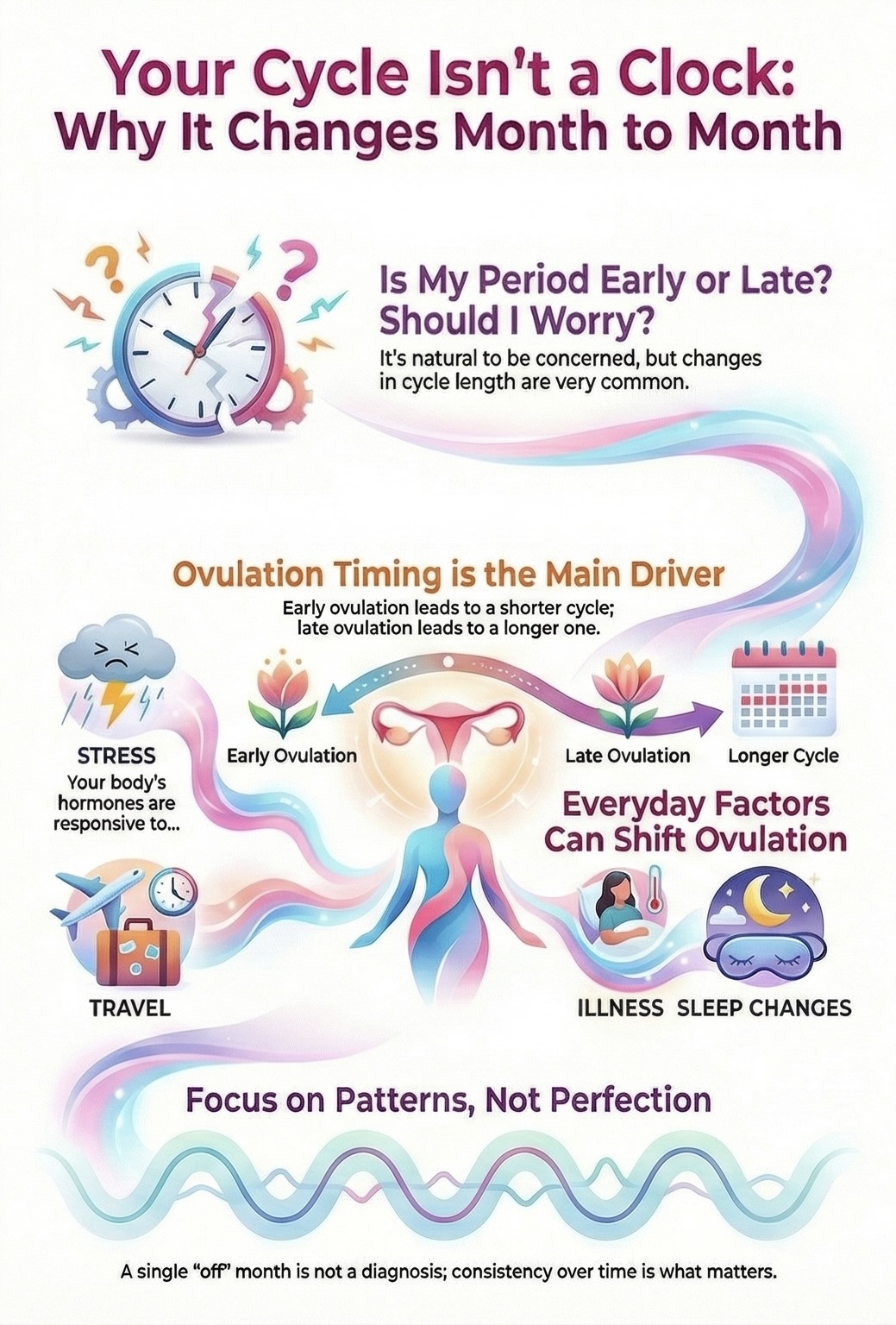
Why Cycle Length Can Change From Month to Month
The role of ovulation timing
The timing of ovulation plays a major role in cycle length. Ovulation is the point in the cycle when an egg is released from the ovary. The days before ovulation can vary quite a bit, while the days after ovulation tend to be more consistent for many people.
If ovulation happens earlier than usual one month, the cycle may feel shorter. If it happens later, the cycle may feel longer. A difference of several days can happen without anything being wrong.
Ovulation timing can shift for many reasons, including changes in stress, sleep, or health. Because ovulation does not run on a strict clock, cycle length naturally changes as well.
How daily life affects the cycle
Hormones are sensitive to the body’s overall environment. This means that everyday experiences can influence cycle timing.
Stress can affect the signals between the brain and the ovaries, sometimes delaying ovulation. This delay can push a period later than expected.
Illness, even something short-term like a cold or flu, can temporarily change how the body prioritizes energy, which may also affect hormone timing.
Travel and schedule changes can disrupt sleep patterns, meal timing, and daily routines. Crossing time zones or shifting work schedules can influence the body’s internal rhythms.
Sleep changes on their own can affect hormone balance. Periods of poor or inconsistent sleep may coincide with cycle shifts.
These influences do not mean the body is malfunctioning. They reflect how responsive the menstrual cycle is to real life.
Common experiences people notice
Many people notice that most of their cycles are similar, but one cycle stands out as longer or shorter. Others experience occasional skipped periods, especially during stressful times or major life changes.
It is also common for cycle length to change at different life stages. Early cycles, cycles later in adulthood, and cycles around transitions often look different from what came before.
Some people notice that bleeding starts later even though they feel “on schedule” emotionally or physically. Others notice the opposite — an early period with no clear explanation.
These experiences are shared by many and are part of the broad range of normal cycles.
Why one irregular month isn’t a diagnosis
A single late or early period does not usually point to a health condition. Bodies are allowed to have off months. One cycle that differs from the usual pattern often reflects a temporary shift rather than an ongoing issue.
Medical definitions of irregular cycles are based on repeated patterns over time, not isolated changes. Looking at trends across several months provides more useful information than focusing on a single cycle.
It can help to think in terms of patterns rather than perfection. Consistency over time matters more than any one cycle landing outside expectations.
What is generally considered normal
Cycle lengths vary widely among healthy people. Some cycles are shorter, others longer, and many change slightly from month to month. A variation of several days between cycles is often considered normal.
Periods arriving a few days earlier or later than expected can happen even in people who usually have regular cycles. Occasional missed or delayed periods can also occur during times of stress, illness, or significant lifestyle changes.
Normal cycles are defined by ranges, not exact numbers. There is no universal “correct” cycle length.
When it can make sense to seek medical advice
While variation is common, there are times when it can be helpful to talk with a healthcare professional. For example, cycles that become consistently very irregular, periods that stop for several months without explanation, or bleeding that is unusually heavy or prolonged may be worth discussing.
Sudden changes that persist over multiple cycles, or symptoms that interfere with daily life, can also be reasons to seek guidance. Reaching out is about gaining understanding and reassurance, not assuming something is wrong.
A calm conclusion
Cycle length changes because bodies are responsive, not because they are failing. Ovulation timing shifts, hormones respond to life events, and cycles adapt accordingly. One early or late period is usually part of normal variation, not a sign of a problem.
Paying attention to overall patterns over time, rather than single changes, can help reduce anxiety and build trust in the body’s natural rhythms.