
Many people grow up with the idea that a “normal” period arrives on the same day every month, lasts the same number of days, and causes little to no discomfort. When real experiences don’t match that picture, it can lead to worry, self-doubt, or the feeling that something is wrong. In reality, that picture is far narrower than how periods actually work for most people.
Understanding what normal really looks like — in all its variation — can ease anxiety and help replace comparison with perspective.
What Normal Periods Really Look Like
Rethinking what “normal” means
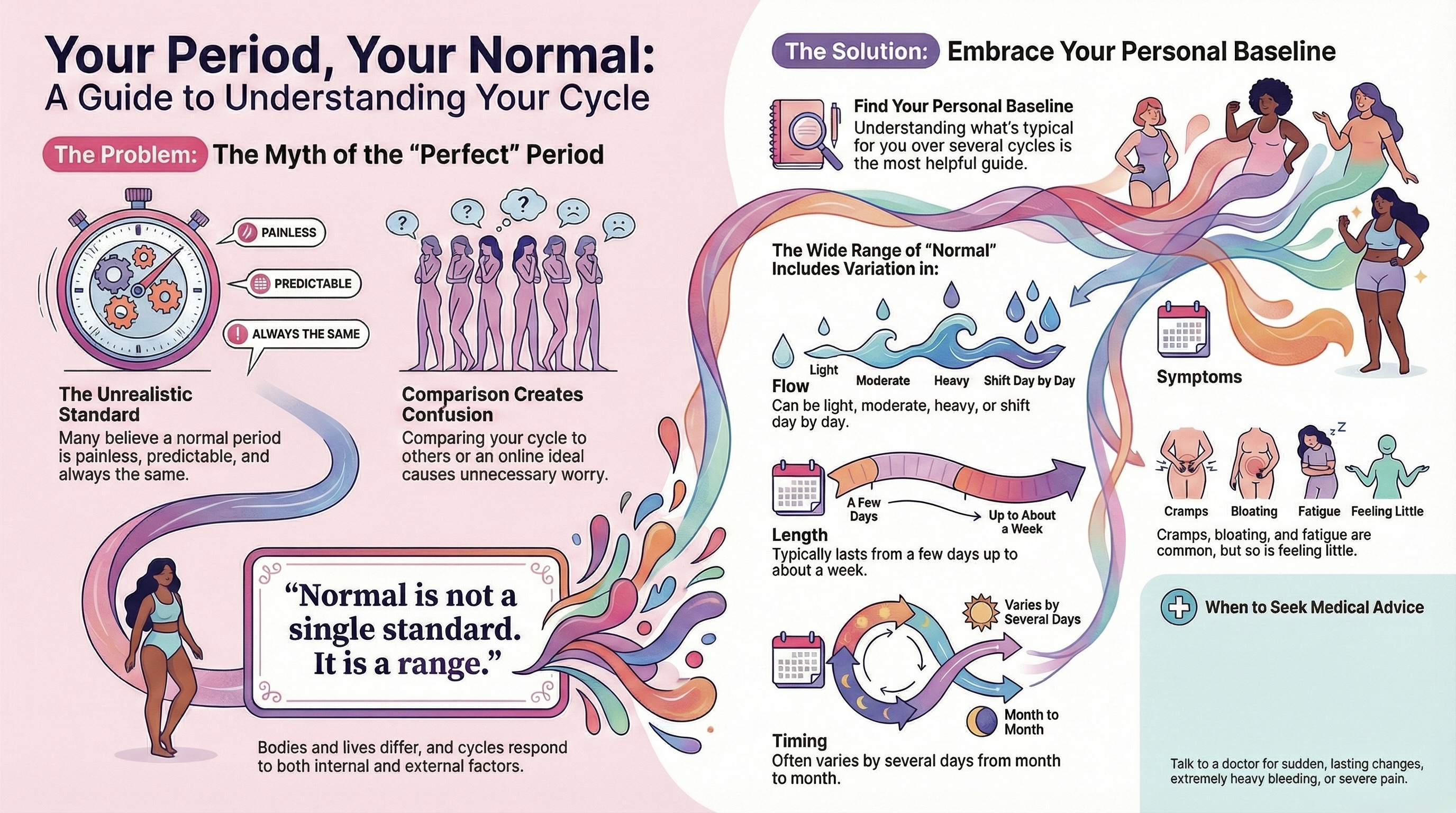
When it comes to periods, normal is not a single standard. It is a range. Bodies differ, lives differ, and cycles respond to both. Expecting a perfectly timed, painless cycle sets an unrealistic bar that many healthy people never meet.
A period is shaped by hormones, stress, sleep, health, age, and countless everyday factors. Because those influences change, periods often change too. Normal includes consistency, but it also includes fluctuation.
Common experiences people notice
Periods vary in several key ways, even for the same person over time.
Flow can be light, moderate, heavy, or shift day by day. Some people have a steady flow, while others notice heavier days followed by lighter ones. Small clots can appear, especially on heavier days, and color can range from bright red to dark brown.
Length also varies. Some periods last only a few days, while others last closer to a week. Starting or ending with a day or two of spotting is common.
Timing is not always exact. Periods may arrive a few days earlier or later than expected, even in otherwise regular cycles. Occasional early or late periods are common.
Sensations and symptoms differ widely. Some people feel cramps, back discomfort, bloating, headaches, or fatigue. Others feel very little physically. Emotional or energy changes can also happen, or not at all.
All of these experiences can fall within the range of normal.
Why comparison isn’t helpful
It’s easy to compare your period to a friend’s, a family member’s, or an idealized version seen online. But comparison often creates confusion rather than clarity.
Two people can both have healthy cycles that look completely different. One may bleed lightly for three days with no pain. Another may bleed more heavily for six days with noticeable cramps. Neither experience is more “correct” than the other.
Even comparing your current cycle to a past version of yourself can be misleading. Bodies change over time, and what was once typical may shift with age, stress, or life circumstances.
The importance of personal baselines
Instead of measuring periods against external standards, it can be more helpful to think in terms of personal baselines. A baseline is what is typical for you over time.
Noticing patterns across several cycles provides more meaningful information than focusing on one month. If your periods usually last five days and one month they last six, that may simply be normal variation. If your flow is usually moderate and occasionally heavier, that can also be part of your baseline.
Personal baselines allow room for change without immediately assuming something is wrong.
What is generally considered normal
From a broad perspective, periods tend to fall within wide ranges:
- Periods often last anywhere from a few days up to about a week.
- Flow can be light, moderate, heavy, or mixed.
- Cycle timing can vary by several days from month to month.
- Some discomfort can be present, while others experience little or none.
Regularity looks different for different people. Some cycles are very predictable, while others shift slightly. Normal does not require pain-free, perfectly timed, or identical periods every month.
What matters more than exact numbers is whether your cycle generally follows a pattern that feels familiar to you.
When it can make sense to seek medical advice
While variation is common, there are times when it can be helpful to talk with a healthcare professional. Bleeding that feels extremely heavy, lasts much longer than usual for you, or suddenly changes in a lasting way may be worth discussing.
Periods that stop for several months without explanation, bleeding between periods, or pain that interferes with daily life can also be reasons to seek guidance. These conversations are about understanding and support, not assuming something is wrong.
Looking at changes across multiple cycles, rather than a single period, often provides the clearest picture.
A calm conclusion
Normal periods are not uniform, silent, or perfectly timed. They come in many lengths, flows, and experiences, and they can change over time. Comparison often creates unnecessary worry, while paying attention to personal patterns builds understanding.
Your period does not need to look like anyone else’s to be normal. Variation is not a flaw — it is part of how bodies work.