
Hormones often get blamed for how people feel during their menstrual cycle. They are described as unpredictable, overwhelming, or “out of control.” In reality, hormones are simply messengers. They rise and fall in patterns that help the body move through each part of the cycle. Understanding what they are doing — without technical language or fear — can make these changes feel more understandable and less alarming.
Hormonal shifts are not signs that something is wrong. They are part of how a healthy cycle works.
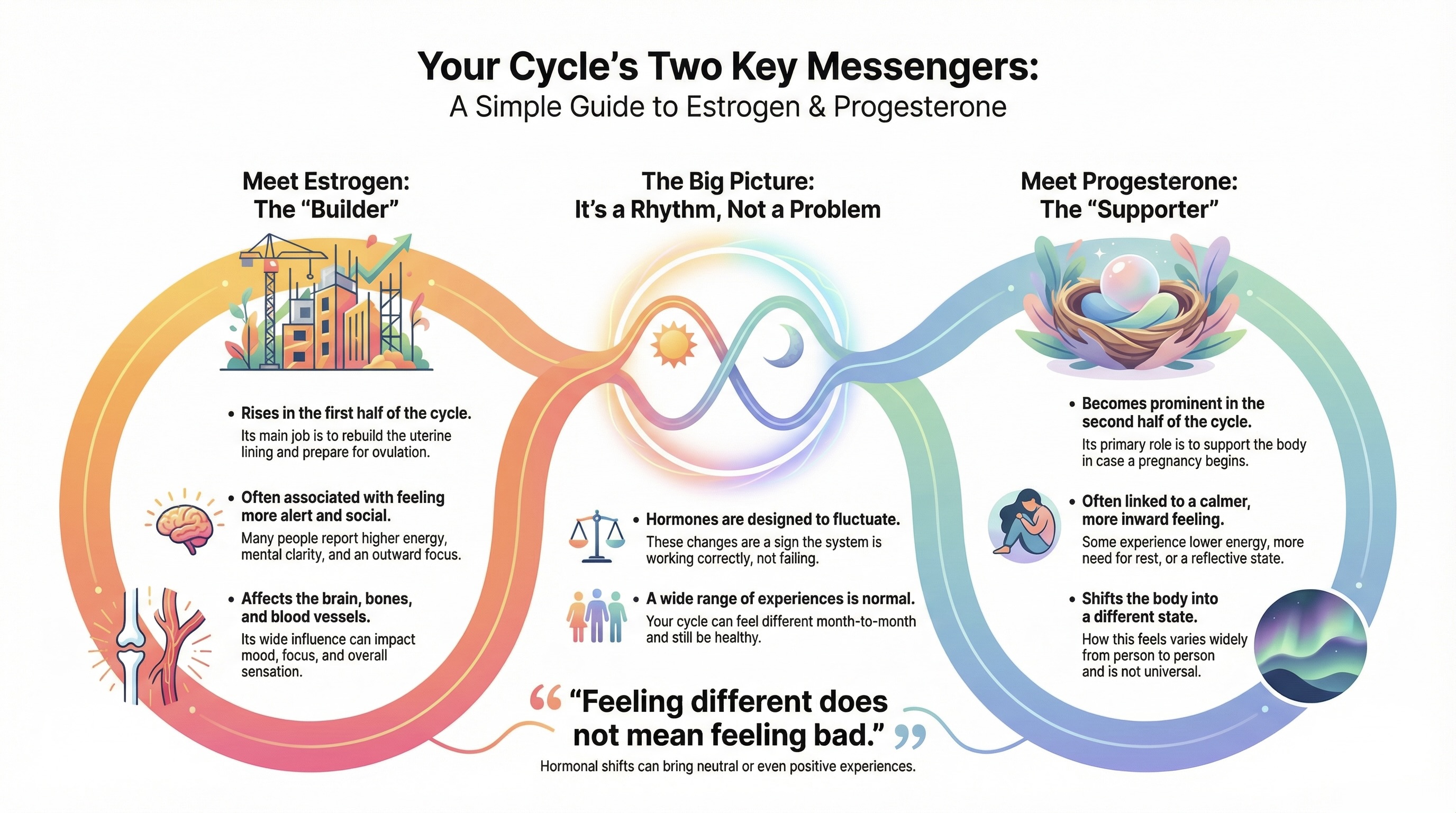
What Hormones Are Doing During Your Cycle
Hormones as messengers, not problems
Hormones are chemical signals that help different parts of the body communicate. During the menstrual cycle, two hormones play especially important roles: estrogen and progesterone.
Rather than acting randomly, these hormones change in a repeating sequence. Their levels go up and down at different points in the cycle, guiding what the body does next. This rhythm is flexible, not rigid, which is why experiences can vary from month to month.
Estrogen, in plain language
Estrogen is often associated with the first half of the cycle. As estrogen rises, it supports the rebuilding of the uterine lining after a period and plays a role in preparing the body for ovulation.
Many people notice that when estrogen is rising, they feel more alert, social, or mentally clear. Some describe feeling lighter or more outward-focused. Physically, this phase can coincide with feeling more energetic or coordinated, though not everyone notices a strong shift.
Estrogen also affects many systems beyond reproduction, including the brain, bones, and blood vessels. Because of this wide influence, changes in estrogen can be felt in mood, focus, skin, and overall sensation.
Progesterone, in plain language
Progesterone becomes more prominent after ovulation. Its role is to support the body in case a pregnancy begins. If pregnancy does not occur, progesterone levels eventually fall, leading into the next period.
Progesterone is often associated with a more inward, steadying effect. Some people feel calmer, slower, or more reflective during this phase. Others notice lower energy, increased need for rest, or changes in appetite or sleep.
These experiences are not universal. Progesterone does not “cause” a specific mood or feeling; it simply shifts the body into a different state. How that feels varies widely from person to person.
How hormonal changes can affect daily experience
Because estrogen and progesterone interact with many systems in the body, their natural shifts can influence energy levels, emotions, and physical sensations.
Some people notice predictable patterns across their cycle, while others experience more subtle or inconsistent changes. Mood may feel different at different points, without being extreme or disruptive. Energy may rise and fall gradually. The body may feel more or less sensitive, bloated, or comfortable at different times.
Importantly, feeling different does not mean feeling bad. Hormonal shifts can bring a range of neutral or even positive experiences, as well as more challenging ones. There is no single “correct” way a cycle is supposed to feel.
Why hormonal shifts don’t mean something is wrong
Hormones are designed to fluctuate. A completely flat, unchanging hormonal pattern would not support a menstrual cycle at all. The presence of change is a sign that the system is working, not failing.
It is also common for hormonal experiences to change over time. Stress, aging, health, sleep, and life circumstances all influence how hormones behave and how their effects are felt. A cycle that feels different than it used to does not automatically indicate a problem.
Language that frames hormones as enemies or flaws can increase anxiety. In reality, they are adaptive signals responding to the body’s needs and environment.
What is generally considered normal
There is a wide range of normal when it comes to hormonal experiences. Some people feel clear phase-to-phase differences; others feel relatively steady throughout the month. Emotional sensitivity, changes in energy, or shifts in focus can all fall within normal patterns.
Hormonal changes do not need to be dramatic to be real, and they do not need to match anyone else’s experience to be valid. Normal includes variation between people and variation within the same person over time.
When it can make sense to seek medical advice
While hormonal shifts are expected, there are times when additional support can be helpful. Symptoms that feel overwhelming, persist across many cycles, or significantly interfere with daily life may be worth discussing with a healthcare professional.
Sudden or severe changes that continue over time, rather than appearing occasionally, can also be reasons to seek guidance. Asking questions is a way to better understand your body, not an admission that something is wrong.
A calm conclusion
Hormones during the menstrual cycle are not forces to fear or control. Estrogen and progesterone rise and fall in patterns that support the cycle’s natural rhythm. These shifts can influence how the body and mind feel, but they do not define what is normal or acceptable.
Understanding hormones as messengers — flexible, responsive, and variable — can help bring clarity and calm to experiences that are often misunderstood.