
The menstrual cycle is often talked about as a countdown to a period or a number of days on a calendar. But at its core, the cycle is less like a strict schedule and more like a repeating rhythm. Understanding it as a pattern — one that naturally shifts and varies — can make changes feel more normal and less confusing.
This broader view helps explain why cycles don’t always look the same from month to month, and why variation is not only common, but expected.
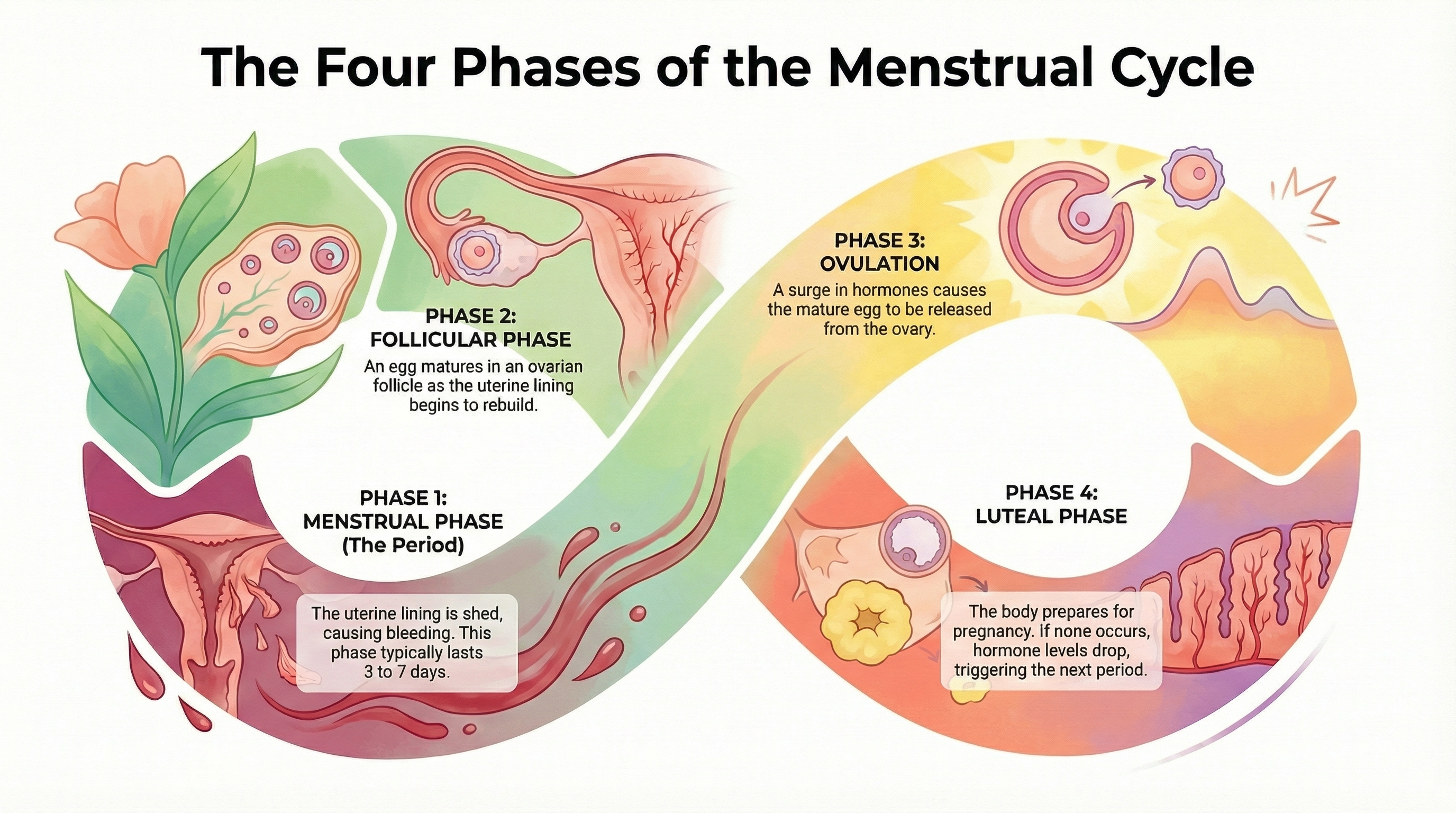
Diagram of cycle phases
The menstrual cycle as a repeating rhythm
The menstrual cycle is the body’s way of preparing for a possible pregnancy and then resetting when one does not happen. This process repeats again and again over many years, guided by hormones that rise and fall in a predictable sequence — though not on a perfectly fixed timeline.
Instead of thinking about the cycle as a single event, like bleeding, it helps to think of it as a full loop with different phases. Each phase reflects a shift in hormones and in what the body is doing at that time.
A simple overview of the four phases
Menstrual phase
This phase begins when bleeding starts. The uterus sheds the lining it built during the previous cycle. For some people, this phase feels quiet or low-energy; for others, it barely feels different from any other time. Bleeding can last a few days or up to about a week.
Follicular phase
After bleeding ends, the body begins preparing for the next cycle. Hormones gradually rise, and the uterine lining starts to rebuild. This phase can overlap with the menstrual phase and often brings a gradual return of energy or focus, though not everyone notices a clear shift.
Ovulatory phase
Around the middle of the cycle, hormone levels peak and an egg is released from the ovary. Some people notice subtle signs during this time, such as changes in cervical fluid or a brief sensation on one side of the lower abdomen. Others notice nothing at all. Ovulation does not happen on the same day every cycle, and its timing can vary.
Luteal phase
After ovulation, hormone levels change again as the body waits to see if pregnancy begins. If it does not, hormone levels eventually fall, signaling the uterus to shed its lining. This phase can last different lengths of time for different people and may come with changes in mood, energy, appetite, or sleep.
Why cycles aren’t perfectly predictable
Hormones respond to the body’s internal and external environment. Stress, illness, travel, aging, sleep patterns, and life changes can all influence when hormones rise or fall.
Because of this, cycles can shift by a few days or more without anything being wrong. Ovulation might happen earlier one month and later the next. Bleeding may start sooner or later than expected.
Rather than being a flaw, this flexibility reflects the body’s ability to adapt. A cycle that occasionally changes timing is often functioning normally.
Common experiences and variations
People experience the menstrual cycle in many different ways. Some feel noticeable changes across the phases, while others experience their cycle as fairly steady throughout the month.
Energy levels may rise and fall. Emotions can feel different at different points. Physical sensations, digestion, focus, and sleep can all shift subtly or more noticeably.
Cycle length also varies. Some people have shorter cycles, others longer ones, and many fall somewhere in between. The length of bleeding, the amount of flow, and the presence or absence of discomfort can change over time.
These variations are part of the normal range of human cycles, not signs of failure or imbalance.
What is generally considered normal
In general, menstrual cycles fall within a wide range. Cycles that are shorter or longer than the often-cited “28 days” can still be completely normal. Bleeding for a few days up to about a week is common. Flow can be light, moderate, heavy, or change from day to day.
Regularity looks different for different people. Some cycles are very consistent, while others shift slightly from month to month. Over a lifetime, cycles often change due to age, stress levels, and life circumstances.
Normal does not mean identical every time. Normal means that a wide spectrum of patterns exists without indicating a problem.
When it can make sense to seek medical advice
While variation is expected, there are moments when professional input can be helpful. Cycles that suddenly change in a major way, bleeding that is unusually heavy or prolonged, or symptoms that significantly interfere with daily life may be worth discussing with a healthcare professional.
Missing periods for extended stretches, bleeding between periods, or pain that feels overwhelming can also be reasons to seek clarity. Asking questions is about understanding what is happening in your body, not assuming something is wrong.
A calm conclusion
The menstrual cycle is a repeating hormonal rhythm, not a rigid schedule. Hormones rise and fall, the body prepares and resets, and the timing naturally shifts over time. No two cycles — or people — are exactly alike.
Seeing the cycle as a pattern rather than a rulebook can make it easier to trust your body and understand its changes without fear or pressure.