
Periods are often described as “bleeding once a month,” but that description leaves out most of what is actually happening. For many people, periods are a regular part of life, yet the underlying process can still feel unclear or even mysterious. Understanding what a period is — in simple, non-clinical terms — can make changes and differences feel less confusing and less alarming.
At its core, a period is not something going wrong. It is the body completing a cycle and resetting itself.
Period
The uterine lining and why it sheds
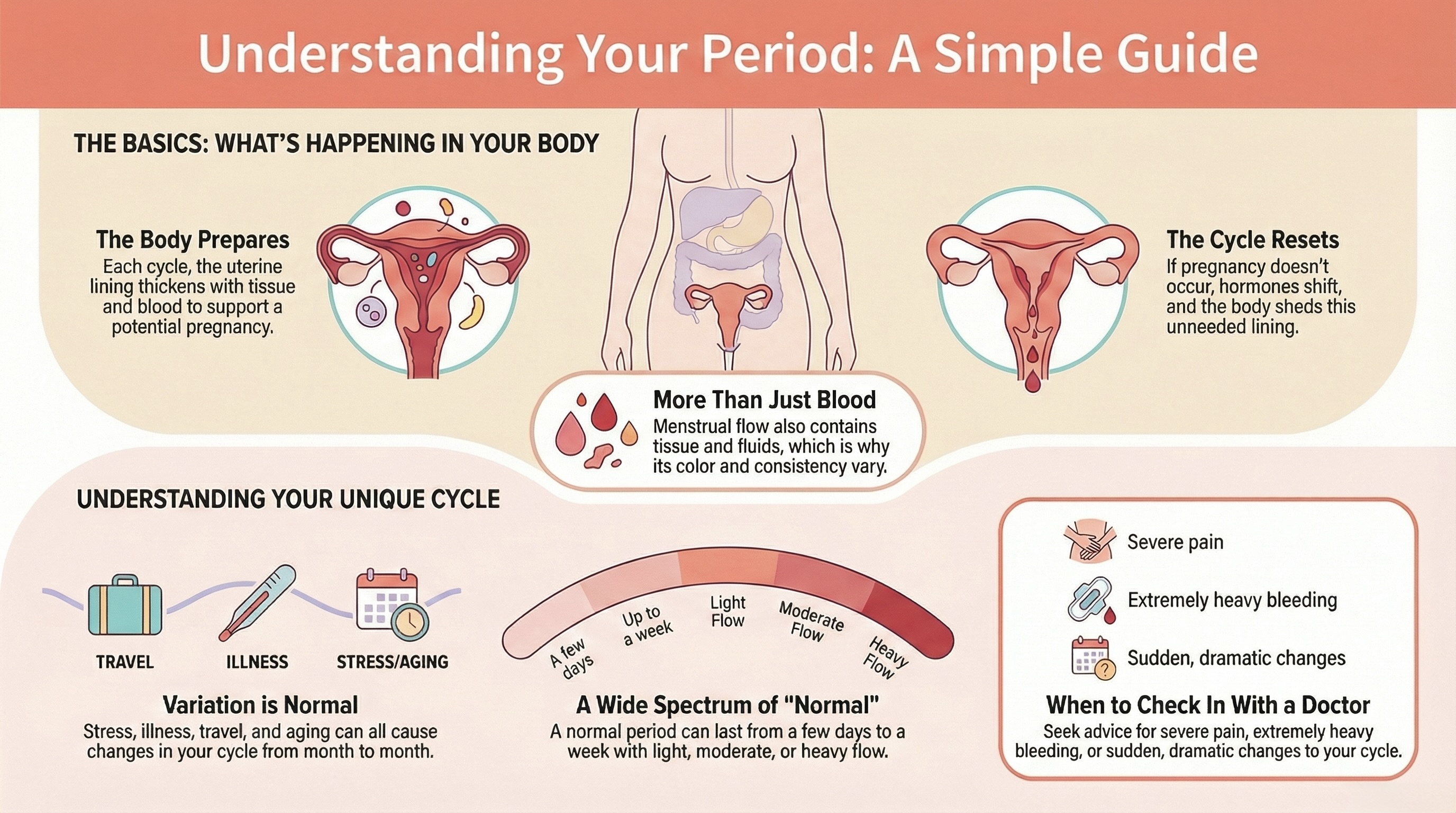
Inside the uterus is a soft, spongy layer called the uterine lining. Over the course of a cycle, this lining gradually thickens. It is made of tissue, blood vessels, and cells, and its role is to create a supportive environment in case a pregnancy begins.
If a pregnancy does not occur during that cycle, the body no longer needs this lining. Hormone levels shift, and the uterus releases the lining. This release is what shows up as menstrual bleeding.
The blood seen during a period is only part of what leaves the body. Menstrual flow also includes tissue from the lining and natural fluids. This is why period blood can look different from a typical cut or scrape — it may appear thicker, darker, or mixed with small clots.
A period, then, is not a failure or a problem. It is simply the body clearing out what it no longer needs.
Why bleeding can change from month to month
Many people notice that their periods are not identical every cycle. One month may be lighter, another heavier. Some cycles last a few days longer or shorter. These differences are usually tied to normal changes in hormones and in how much lining built up that month.
Stress, illness, sleep changes, travel, aging, and life transitions can all influence how a cycle unfolds. Even without an obvious reason, variation can still happen. Bodies are not machines, and cycles are not exact schedules.
Flow can also change over time. Early cycles, cycles later in life, and cycles after major life events often look different from what came before. None of this automatically means something is wrong.
Common experiences people notice
People experience periods in many different ways. Some notice cramping or a heavy sensation in the lower abdomen as the uterus contracts to release the lining. Others feel changes in energy, digestion, or mood around the same time.
Blood color can range from bright red to dark brown. Clots can appear, especially on heavier days. Some days may start or end with spotting rather than a steady flow.
These experiences exist on a wide spectrum. Comparing one person’s period to another’s often creates unnecessary worry, because there is no single “correct” version.
What is generally considered normal
In broad terms, periods commonly last anywhere from a few days to about a week. Flow can be light, moderate, heavy, or a mix that changes over the course of the period. Some discomfort can be part of the experience, while others feel very little.
Regularity also varies. Some cycles arrive like clockwork, while others shift by a few days each month. Occasional irregularity can be part of normal life, especially during times of stress or transition.
Normal does not mean identical, painless, or perfectly predictable. Normal means that a wide range of patterns can exist without indicating a health problem.
When it can make sense to seek medical advice
While variation is common, there are times when reaching out to a healthcare professional can be helpful. For example, bleeding that is extremely heavy, lasts much longer than usual for you, or suddenly changes in a dramatic way may be worth discussing.
Severe pain that interferes with daily life, frequent missed periods without explanation, or bleeding between periods are also situations where professional guidance can provide clarity.
Seeking medical advice is not about assuming something is wrong. It is about getting support and information when something feels different or concerning.
A calm takeaway
A period is the body completing a cycle, not a sign of failure or imbalance. The uterine lining builds up, sheds when it is no longer needed, and then the process begins again. Differences in timing, flow, and sensation are common and expected.
Understanding periods as a natural, variable process can make them feel less confusing and less stressful. Your experience does not need to match anyone else’s to be valid.