
Tracking your menstrual cycle is often talked about as a way to predict the future or gain control over your body. That framing can create pressure and disappointment when cycles don’t behave predictably. In reality, tracking is most useful as a tool for awareness. It helps reveal patterns over time, not perfect answers.
When approached gently, tracking can support understanding rather than expectation.
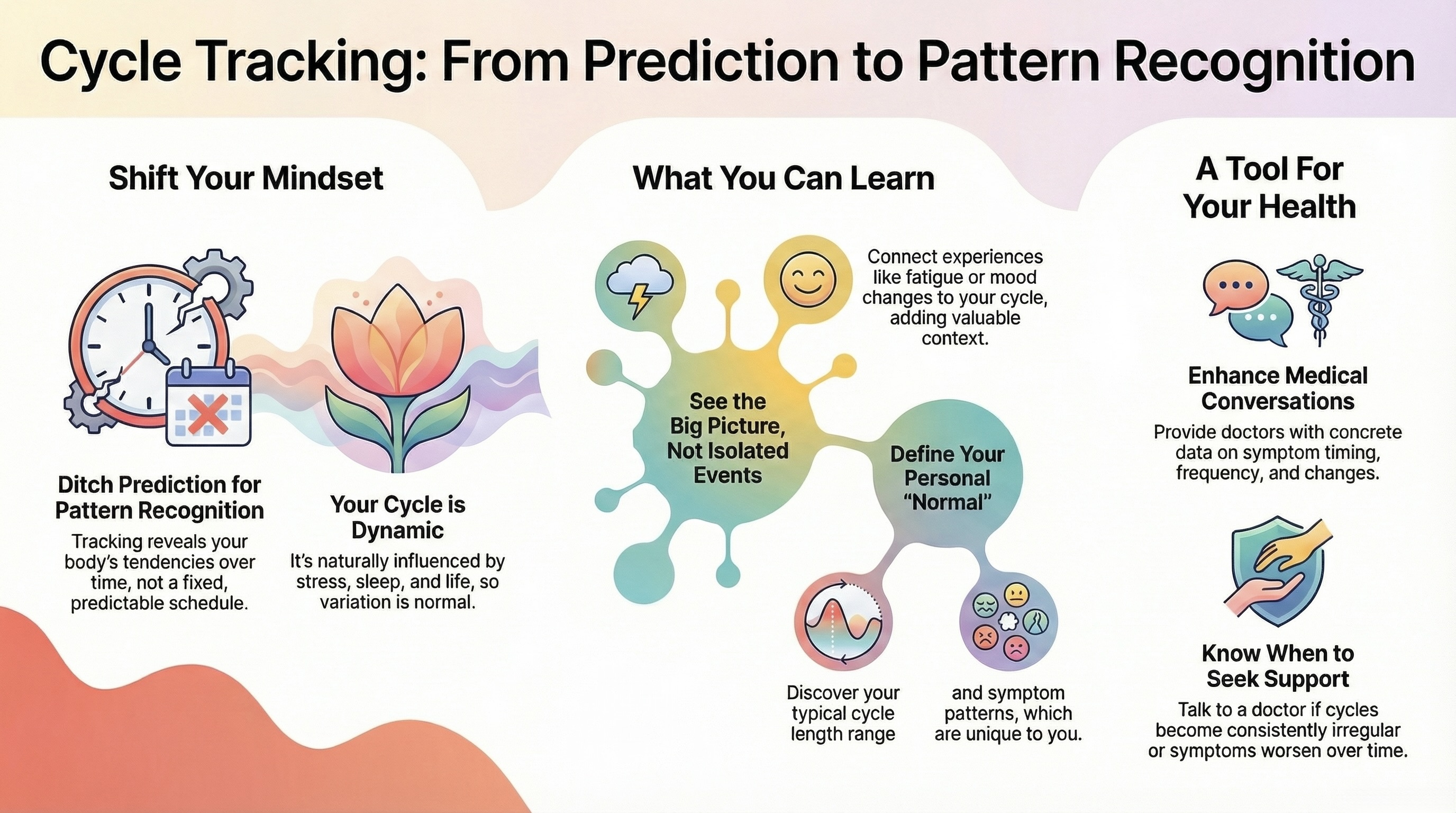
What Tracking Your Cycle Can Help You Notice
Tracking as pattern recognition, not prediction
The menstrual cycle is influenced by hormones, health, stress, sleep, and life circumstances. Because these factors change, cycles can change too. Tracking does not turn the cycle into a fixed schedule. Instead, it creates a record of what has happened across time.
Looking back over several cycles often reveals patterns that are hard to see in the moment. You might notice that periods tend to arrive within a certain range, or that symptoms cluster around similar points in the cycle. These patterns can exist even when individual cycles vary.
Prediction assumes consistency. Pattern recognition allows for flexibility.
Seeing context instead of isolated data points
Single data points rarely tell the full story. One late period, one painful cycle, or one unusually light flow does not usually mean much on its own. Tracking becomes more meaningful when information is viewed together.
For example, noticing that fatigue often appears before periods during stressful months adds context that a single tired day does not. Seeing that cramps tend to be stronger in cycles with heavier bleeding can also provide perspective.
Tracking helps connect experiences rather than isolate them. It shifts the focus from “What is wrong this month?” to “What tends to happen over time?”
Common things people begin to notice
Many people notice that their cycles fall within a general range rather than a fixed number of days. Periods may arrive a few days earlier or later without following a strict pattern, yet still feel familiar overall.
Some notice that certain symptoms appear repeatedly at similar points in the cycle, such as mood changes before bleeding or increased energy earlier in the cycle. Others notice that symptoms change depending on stress, sleep, or workload.
Tracking can also highlight cycles that feel different from the usual pattern. This does not automatically indicate a problem, but it can help identify when something feels new or worth paying attention to.
Understanding normal variation through tracking
Tracking often reinforces how much variation is normal. Seeing cycles laid out over time can make it clear that change is part of the pattern, not a deviation from it.
A cycle that lasts longer one month and shorter the next may still fall within a normal range for that person. Tracking helps show that regularity does not require identical cycles.
Normal patterns look different for different people. Tracking helps define what is typical for you, rather than comparing to external standards.
How tracking can support medical conversations
When questions or concerns come up, having a record of cycles and symptoms can be helpful in conversations with healthcare professionals. It provides concrete information about timing, frequency, and patterns.
Instead of relying on memory alone, tracking can help describe how often something happens, how long it has been occurring, and whether it is changing over time. This context can make discussions more focused and productive.
Tracking does not replace professional evaluation, but it can support clearer communication.
The limits of tracking
While tracking can be informative, it has limits. Data cannot capture everything about how the body feels. Numbers and dates do not fully reflect emotional experience, physical sensation, or intuition.
It is also possible to become overly focused on tracking, especially when expectations shift toward control or prediction. When tracking creates anxiety rather than understanding, it may be helpful to step back and return to a broader view.
Tracking works best when paired with bodily awareness, not when it replaces it.
What is generally considered normal
Normal tracking patterns include variation, gaps, and changes over time. Cycles that shift with stress, travel, illness, or life changes can still be healthy.
Not everyone finds tracking equally useful. Some people benefit from detailed records, while others prefer a lighter approach. Normal includes both.
What matters most is whether tracking supports understanding rather than pressure.
When it can make sense to seek medical advice
Tracking may highlight patterns that prompt questions. Cycles that become consistently irregular, symptoms that worsen over time, or changes that persist across several cycles may be worth discussing with a healthcare professional.
Tracking can help identify when something feels different from your usual baseline. Seeking advice in those moments is about clarity and support, not about assuming a problem.
A calm conclusion
Tracking your cycle can help you notice patterns, context, and change over time. Its value lies in awareness, not prediction or control. Data can inform understanding, but it does not replace lived experience or bodily signals.
When used gently, tracking becomes a way to observe rather than judge — a tool for learning how your cycle tends to move, adapt, and respond to life.