
Cycle tracking can be a helpful way to notice patterns over time, but it can also create expectations that bodies aren't designed to meet. When a predicted date feels off, or symptoms don't line up with a calendar, it's easy to wonder what went wrong. Understanding the limits of tracking can help set more realistic expectations and reduce unnecessary worry.
Tracking works best as a reference point, not a rulebook.
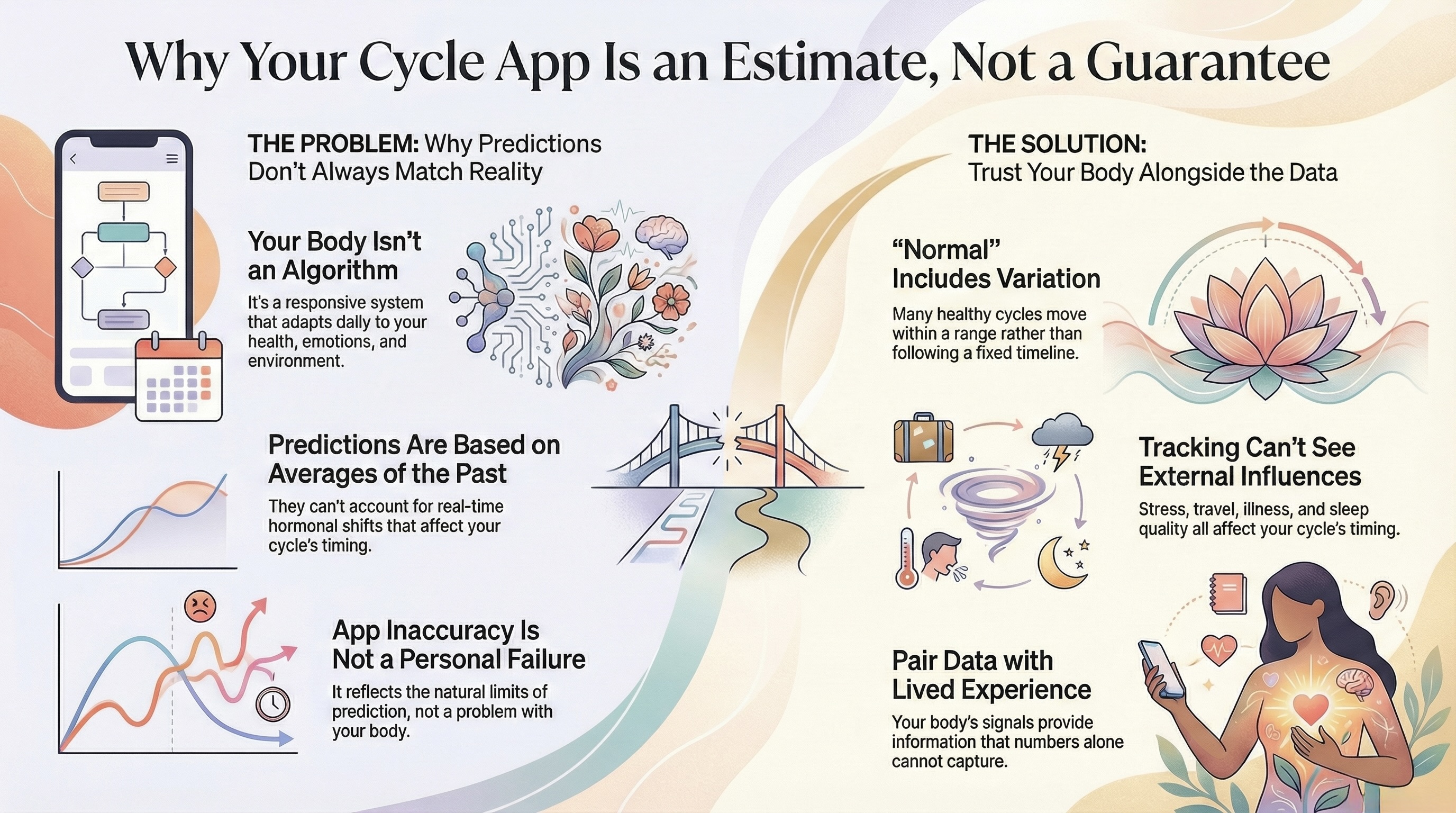
What Tracking Can't Predict
Bodies aren't algorithms
Calendars and charts work by looking at past information and projecting it forward. Human bodies do not operate that way. The menstrual cycle is guided by hormones that respond to many signals at once, including physical health, emotional state, and environment.
Because these signals change from day to day, the cycle adapts in real time. This flexibility is a strength, not a flaw. It allows the body to respond to illness, stress, travel, or major life changes. It also means that no system — digital or otherwise — can fully predict what a body will do next.
Tracking reflects averages and trends. Bodies live in the present.
The limits of prediction accuracy
Predictions are based on past cycles, often assuming that future cycles will follow a similar pattern. Sometimes they do. Sometimes they don't.
Ovulation timing can shift from month to month, even in people with generally regular cycles. Because ovulation plays a major role in determining when a period arrives, small changes can affect timing by several days or more.
Predictions also struggle with cycles that naturally vary in length. A body that tends to cycle within a range rather than a fixed number of days may never align perfectly with a predicted date — and that can still be completely normal.
Inaccuracy does not mean tracking has failed. It means prediction has limits.
External influences tracking can't see
Tracking tools can record dates and symptoms, but they can't fully capture context. Many factors that influence the cycle happen outside what a calendar can measure.
Stress levels, emotional load, sleep quality, illness, travel, changes in routine, and life transitions all affect hormonal timing. Even subtle shifts can influence when ovulation happens or how a period feels.
Tracking also can't see how the body prioritizes energy during different phases of life. A demanding month at work, caregiving responsibilities, or emotional strain may affect the cycle in ways that aren't obvious on a chart.
These influences are real, even when they aren't visible in data.
Common experiences people notice
Many people notice that predictions feel accurate for a few months and then suddenly feel off. Others find that predicted dates are consistently a little early or late.
Some notice that symptoms don't match what the calendar suggests. Energy dips may come earlier than expected. Mood changes may show up at different times. Periods may arrive without following the predicted sequence.
These experiences are common and shared by many. They reflect normal biological variability, not personal error or inconsistency.
What is generally considered normal
Normal cycles include variation. Normal includes cycles that don't land on the same day every month and symptoms that don't follow a script.
Normal also includes learning that predictions are estimates, not guarantees. A cycle that shifts by a few days, or even more during stressful times, can still be healthy.
Regularity does not require perfect predictability. Many healthy cycles move within a range rather than following a fixed timeline.
Trusting lived experience alongside data
Tracking can offer helpful context, but it works best when paired with attention to lived experience. Physical sensations, emotional shifts, and intuitive awareness provide information that numbers alone cannot.
Noticing how the body feels in the moment can sometimes be more informative than what a calendar predicts. When the body signals rest, discomfort, or change, those signals deserve attention even if they don't match expectations.
Data can support awareness, but it doesn't override bodily knowledge.
When tracking may raise questions
Sometimes tracking highlights patterns that feel unfamiliar or concerning. Cycles that change dramatically over several months, periods that stop for extended stretches, or symptoms that steadily worsen may prompt questions.
In these cases, tracking can be a useful reference in conversations with healthcare professionals. It helps describe timing and patterns, but it does not provide answers on its own.
Seeking medical advice is about understanding what is happening, not about correcting imperfect predictions.
When it can make sense to seek medical advice
Medical guidance can be helpful if cycles become consistently irregular, bleeding patterns change significantly over time, or symptoms interfere with daily life. Tracking can help clarify when changes are persistent rather than occasional.
Reaching out does not mean something is wrong. It simply opens the door to professional insight and reassurance when questions arise.
A calm conclusion
Tracking can show patterns, but it cannot predict everything. Bodies are adaptive, responsive systems shaped by both hormones and life. No calendar can fully capture that complexity.
Understanding what tracking can't predict helps reduce pressure and self-doubt. Data is one source of information, not the final authority. Lived experience matters, and trusting it is part of understanding your cycle.