
Emotional shifts across the menstrual cycle are often talked about in oversimplified ways. Feelings get attributed to “just hormones,” which can make real experiences feel dismissed or stigmatized. In reality, mood changes are shaped by a combination of hormonal rhythms and everyday life. Understanding this interaction can help normalize emotional variation without reducing it to a single cause.
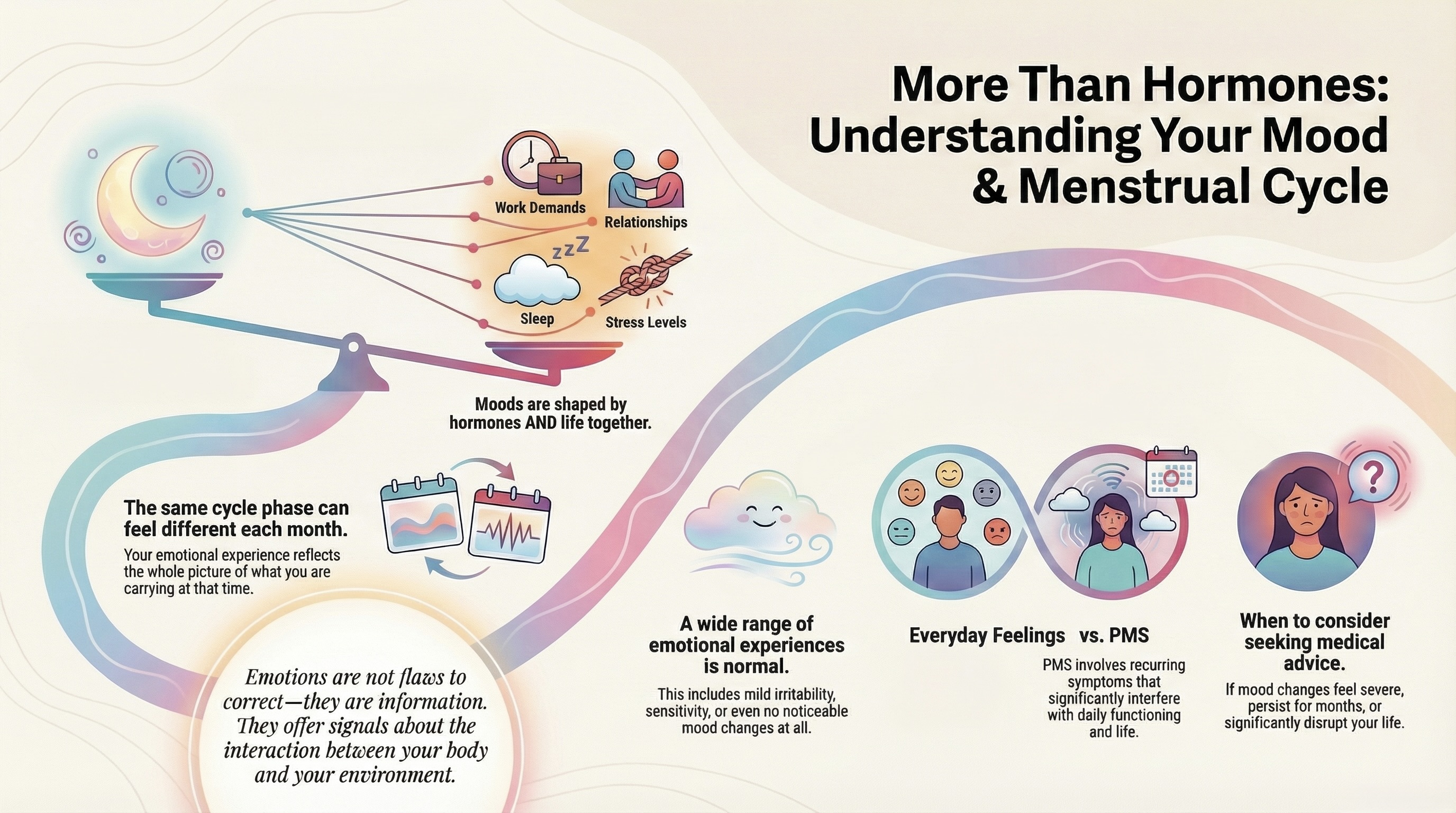
Emotions during the cycle are not flaws to correct. They are information, shaped by both biology and context.
Mood Changes Across the Cycle
Mood as part of a larger picture
Hormones do influence the brain. As estrogen and progesterone rise and fall across the cycle, they affect chemical messengers involved in mood, stress response, and emotional processing. These shifts can gently change how emotions are felt or expressed at different times.
At the same time, hormones do not act in isolation. Work demands, relationships, mental load, sleep quality, past experiences, and current stress all interact with hormonal changes. A cycle does not happen in a vacuum, and emotions reflect the whole picture of what a person is carrying.
This is why the same phase of the cycle can feel very different from one month to the next.
Hormones and life stress working together
Hormonal changes can make emotions feel closer to the surface. For some people, this shows up as increased sensitivity, irritability, or tearfulness. For others, it looks like lower motivation or a need for more quiet and space.
Life stress can amplify these effects. A demanding week, unresolved conflict, or ongoing pressure can feel heavier during certain points in the cycle. Conversely, during calmer periods of life, emotional shifts may feel subtle or barely noticeable.
This interaction does not mean emotions are exaggerated or imagined. It reflects how the nervous system responds when multiple factors overlap.
Common experiences people notice
People report a wide range of emotional patterns across their cycles. Some notice feeling more outward, confident, or socially engaged at certain times. Others notice more inward, reflective, or sensitive moods later in the cycle.
Some experience irritability or frustration that feels out of proportion to events. Others feel sadness, anxiety, or emotional fatigue. Many notice no strong mood changes at all.
Importantly, emotional patterns are not fixed. They can change with age, stress levels, sleep, and life circumstances. A cycle that once felt emotionally easy may later feel heavier, and then shift again.
PMS versus everyday emotional range
Premenstrual syndrome (PMS) is often used as a catch-all term for any emotion felt before a period. In reality, PMS refers to a cluster of symptoms that recur regularly and significantly affect daily functioning.
Everyday emotional range is broader and more flexible. Feeling more sensitive, thoughtful, or low-energy before a period does not automatically mean PMS. Emotions can fluctuate without crossing into a clinical concern.
Using careful language matters. Not every emotional shift needs a label, and not every difficult feeling is a disorder.
Why observing mood patterns can be helpful
Paying attention to mood patterns over time can provide useful context. Observing when certain emotions tend to show up — and when they don’t — can help separate temporary states from ongoing concerns.
Mood awareness is not about judging feelings or trying to control them. It is about noticing patterns and giving emotions space to exist without surprise or self-blame.
Over time, this awareness can reduce anxiety by replacing “What’s wrong with me?” with “This feels familiar.”
What is generally considered normal
A wide range of emotional experiences can be normal across the menstrual cycle. Mild irritability, sensitivity, lower patience, emotional openness, or the need for more rest and quiet can all fall within typical patterns.
Normal also includes cycles with little emotional change. Not everyone experiences noticeable mood shifts, and that is just as valid.
What matters most is the overall pattern. Emotions that come and go, shift with context, and feel manageable over time often reflect normal variation.
When it can make sense to seek medical advice
There are times when emotional symptoms may be worth discussing with a healthcare professional. Mood changes that feel severe, persist across many cycles, or significantly interfere with relationships, work, or daily life may deserve support.
Emotions that feel overwhelming, hopeless, or disconnected from usual patterns can also be reasons to seek guidance. Reaching out is about care and understanding, not about labeling or minimizing experiences.
Support can help clarify whether symptoms fall within expected variation or whether additional resources may be useful.
A calm conclusion
Mood changes across the cycle are shaped by hormones and life together, not hormones alone. Emotional shifts do not mean instability or weakness, and they do not define a person’s character or capability.
Seeing mood as part of a repeating, flexible rhythm — influenced by both biology and context — can reduce stigma and self-judgment. Emotions across the cycle are signals, not problems to erase.