
Cramps are one of the most common and least clearly explained parts of having a period. For some people, they are a mild background sensation. For others, they are painful and disruptive. Both experiences are real, and neither needs to be minimized or dramatized. Understanding what cramps are — and why they can feel so different from one cycle to the next — can help make sense of an experience that often feels unpredictable.
Cramps are not a personal failure, a lack of toughness, or a sign that the body is doing something wrong. They are part of how the uterus works.
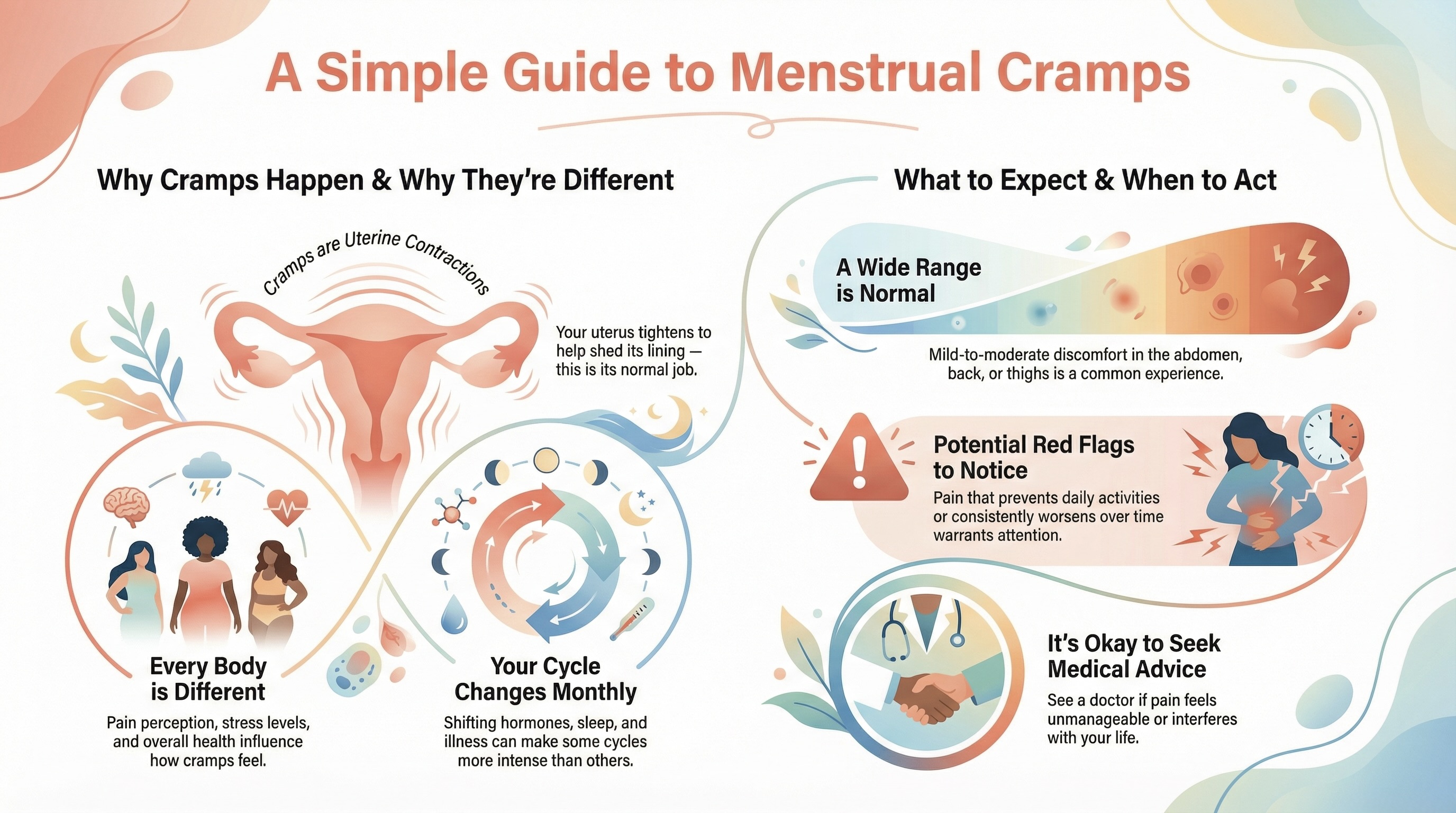
Guide to Menstrual Cramps
What uterine contractions are
During a period, the uterus sheds its lining. To do this, it gently tightens and releases, using muscle contractions to help move the lining out of the body. These contractions are similar in concept to other muscle movements, just happening inside the uterus.
The sensation of cramping comes from these contractions and from temporary changes in blood flow to the uterine muscle. When the muscle tightens, nearby nerves can register discomfort or pain. This process is driven by natural chemical signals involved in the menstrual cycle.
Cramps are not the uterus “fighting” the body. They are the uterus doing its job.
Why cramps feel different from person to person
Not everyone experiences cramps the same way. Some people barely notice them, while others feel significant pain. This variation exists for many reasons.
Bodies differ in how strongly the uterus contracts and how sensitive nerves are to those contractions. Pain perception itself varies widely among individuals and even within the same person over time. Past experiences, stress levels, and overall health can all influence how sensations are felt.
Because of this, there is no single “normal” level of cramping that applies to everyone.
Why some cycles hurt more than others
Even for the same person, cramps can change from month to month. One cycle may feel manageable, while the next feels more intense. This does not mean the body is getting worse or failing.
Hormone levels naturally shift between cycles. These shifts can affect how strongly the uterus contracts and how sensitive the body is to those contractions. Stress, sleep, illness, and emotional load can also influence how pain is perceived.
Ovulation timing and how much uterine lining builds up during a cycle may also play a role. More lining can sometimes mean stronger contractions during shedding, though this is not a strict rule.
Variation from cycle to cycle is common and expected.
Common cramp experiences people notice
Cramps are often felt in the lower abdomen, but they can also radiate to the lower back, hips, or thighs. Some people feel a dull ache, while others feel sharper waves of discomfort.
Cramps may start before bleeding begins, appear on the first day or two of a period, or come and go throughout. They may feel strongest at certain times of day or change with movement and rest.
Some cycles come with noticeable cramps, while others pass with little or no pain. This inconsistency can feel frustrating, but it is a shared experience for many people.
What is generally considered normal
Mild to moderate cramping during a period is common. Discomfort that comes and goes, responds to rest, or feels manageable within daily life often falls within the range of normal experiences.
Normal also includes variation. Having cramps one month and not the next, or having different levels of pain across cycles, can be part of a healthy pattern.
Normal does not mean painless. It also does not mean constant or unbearable. Most people fall somewhere in between, and that range is wide.
The difference between common discomfort and possible red flags
It can be reassuring to know that cramps are common, but it is also important to recognize when pain may deserve more attention.
Cramps that feel severe enough to regularly prevent daily activities, pain that worsens significantly over time, or pain that feels very different from a person’s usual pattern may be worth discussing with a healthcare professional.
Pain that occurs outside of periods, or is accompanied by other concerning changes such as unusually heavy bleeding, can also be a reason to seek guidance. These situations do not automatically indicate a serious problem, but they do warrant clarity and support.
When it can make sense to seek medical advice
Medical advice can be helpful when cramps feel unmanageable, persist across many cycles, or interfere with work, school, or daily life. Sudden changes in pain patterns that continue over time can also be worth exploring.
Reaching out does not mean that pain is being exaggerated or that something must be wrong. It simply opens the door to understanding what is happening in your body and what support options exist.
A calm conclusion
Cramps happen because the uterus contracts to do its job. How those contractions feel varies widely from person to person and from cycle to cycle. Pain can be real without being dangerous, and variation can exist without meaning something is wrong.
Understanding cramps as a common, variable part of menstrual cycles can help reduce fear and self-blame. Your experience does not need to match anyone else’s to be valid.