
Many people hesitate to talk to a doctor about their period. Some worry they’re overreacting. Others worry they won’t be taken seriously. And many assume that discomfort or irregularity is simply something to tolerate. In reality, seeking medical input is a normal part of caring for your health — especially when something feels different from your usual pattern.
This topic matters because knowing *when* it can make sense to ask for professional input can replace anxiety with clarity, without turning normal variation into a medical problem.
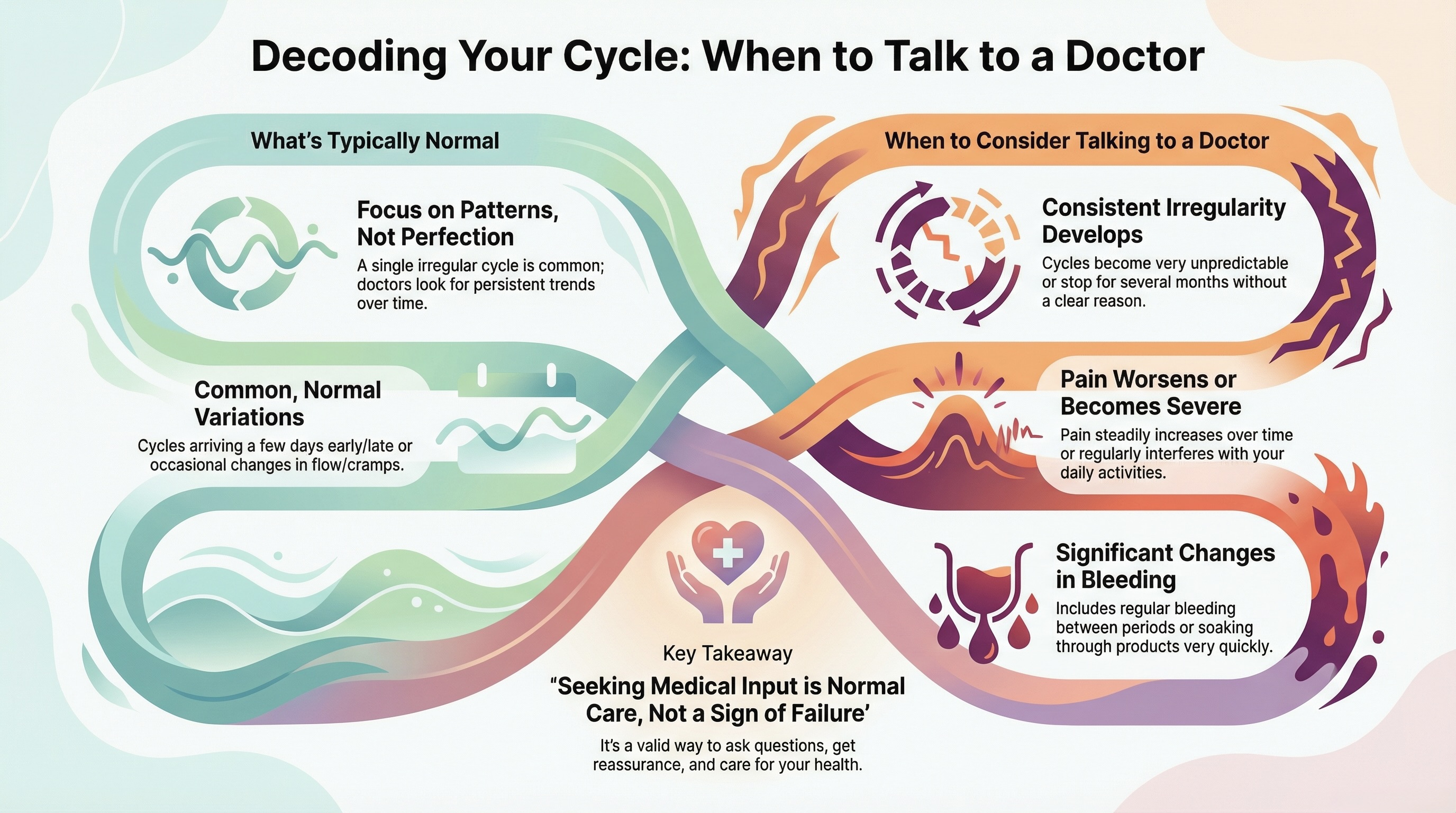
When It Makes Sense to Talk to a Doctor
Understanding the idea of patterns, not perfection
Menstrual cycles are naturally variable. Timing, flow, and symptoms can shift from month to month, especially during stressful periods of life or major transitions. A single “off” cycle is often just that — a single cycle.
What tends to matter more is pattern. Changes that repeat, persist, or gradually intensify over time provide more useful information than one unexpected month. Doctors generally look for trends rather than isolated events.
Thinking in terms of patterns can help reduce the pressure to interpret every change as urgent or abnormal.
Common experiences that don’t usually require medical concern
Many experiences fall within a broad range of normal and often don’t require medical evaluation on their own.
- Periods that arrive a few days early or late.
- Cycles that vary slightly in length.
- Occasional heavier or lighter bleeding.
- Mild to moderate cramps that come and go.
- Fatigue or mood changes around certain points in the cycle.
These experiences are extremely common and often resolve without intervention. Noticing them does not mean something is wrong — it simply reflects that bodies respond to life, stress, and hormonal shifts.
What “normal” usually looks like
Normal menstrual health is not defined by perfect regularity or complete comfort. Normal includes:
- Cycles that fall within a personal range rather than an exact number
- Symptoms that fluctuate across cycles
- Periods that evolve over time
- Months that feel different from one another
A cycle can be healthy even if it is not predictable, painless, or identical each month. Many people with healthy cycles experience variation throughout their lives.
Understanding this can make it easier to distinguish between expected changes and signals that may benefit from professional input.
Pattern-based signs that are worth paying attention to
There are certain changes that, when they repeat or persist, can make it reasonable to talk with a healthcare professional. These are not emergencies in most cases, but they are worth noting.
- Cycles that become consistently very irregular over several months.
- Periods that stop for several months without a clear reason.
- Bleeding that becomes much heavier or lasts much longer than usual for you.
- Pain that steadily worsens or regularly interferes with daily activities.
- Symptoms that feel very different from your long-term baseline.
What matters is not that these experiences happen once, but that they become part of a recurring pattern.
Symptoms that often deserve professional input
Some experiences tend to benefit from medical discussion sooner rather than later, especially when they affect quality of life.
- Pain that feels severe or unmanageable.
- Bleeding between periods that happens regularly.
- Periods that involve soaking through products very quickly.
- Fatigue that feels extreme or persists well beyond the period itself.
- Emotional symptoms that feel overwhelming or disrupt daily functioning.
Seeking input for these experiences is not an overreaction. It is a reasonable step toward understanding what is happening and what support options exist.
Seeking care is normal — not a failure
One of the biggest barriers to seeking care is the fear of being dismissed or told that symptoms are “just part of being a woman.” While that experience does happen, it does not mean your concerns are invalid.
Talking to a doctor is not an admission that something is wrong with your body. It is a way to ask questions, get context, and explore whether additional evaluation is useful.
Even when everything turns out to be within normal limits, many people find reassurance in having that confirmation.
Medical care doesn’t have to mean medicalization
Seeking advice does not automatically lead to tests, medications, or diagnoses. In many cases, conversations focus on understanding patterns, ruling out concerns, and offering reassurance.
Healthcare input can range from “this looks normal for you” to “let’s keep an eye on this” to “here are options if you want support.” It is not an all-or-nothing decision.
The goal is understanding, not intervention for its own sake.
A calm conclusion
Most menstrual changes are part of normal variability. At the same time, it is reasonable to seek medical input when patterns shift, symptoms persist, or something feels meaningfully different from your usual experience.
Talking to a doctor is a normal, valid way to care for your health — not a sign of panic or weakness. Paying attention to your body, noticing patterns, and asking questions when needed is part of long-term wellbeing.